
Bachelor's Degree Attestation Steps for UAE Jobs
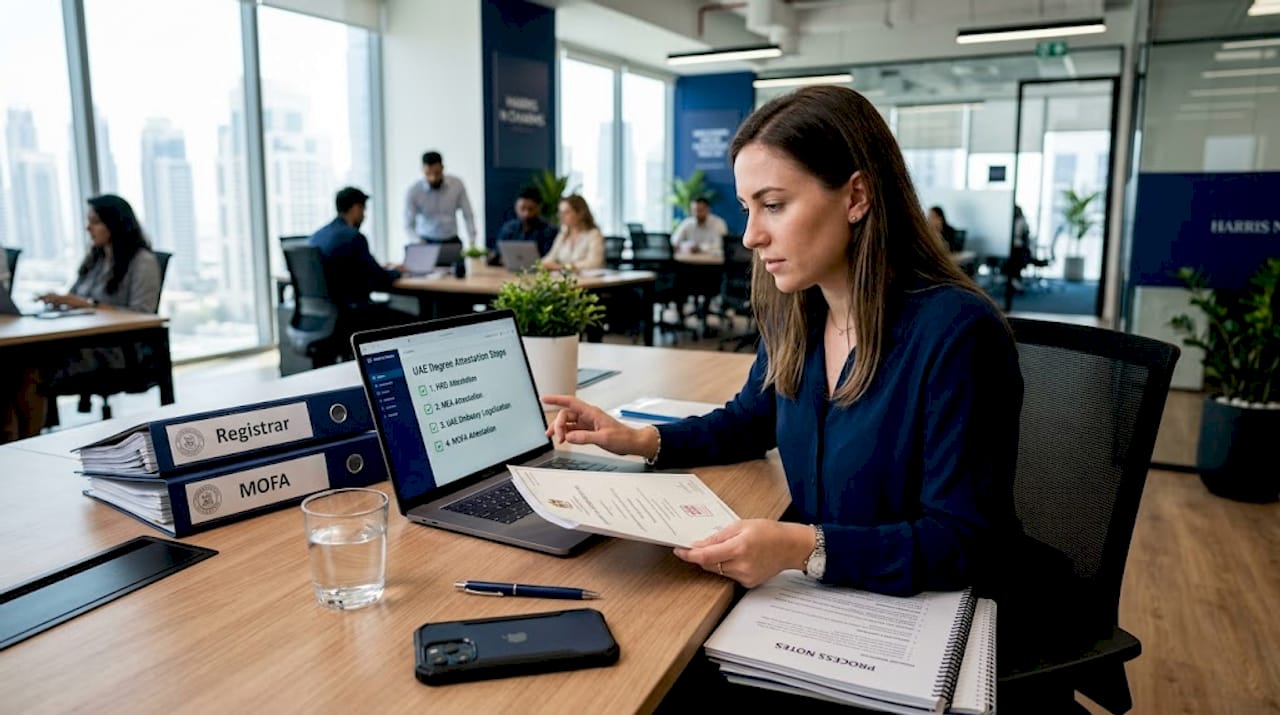
If you’re a Filipino professional or student preparing to work or study in the UAE, understanding the bachelor’s degree attestation steps is not optional. It’s the gate you must pass through before an employer or university will accept your credentials. The process involves multiple government agencies across two countries, each with their own requirements, fees, and timelines. Get one step wrong and you restart. This article gives you every step clearly, with country-specific comparisons and practical tips that actually save you time.
Table of Contents
Key takeaways
Point | Details |
Attestation is a chain process | Each step must be completed in sequence; skipping one invalidates the rest. |
Name consistency is critical | Even a missing middle initial across documents can trigger a costly affidavit requirement. |
Notarization is not attestation | Notarization alone is insufficient for UAE MOFA acceptance; full embassy verification is required. |
UAE MOFA is always the final step | Final attestation must be completed inside the UAE after all foreign attestations are done. |
Country of degree origin matters | Philippines, US, and UK each follow different attestation chains with unique fees and timelines. |
1. Understand the bachelor’s degree attestation steps before you begin
The five-step attestation chain for international degrees moves from university verification all the way to UAE Ministry of Foreign Affairs (MOFA) attestation. Every step has a specific government body, fee, and waiting period attached to it. Many Filipinos arrive at the UAE embassy stage only to discover their documents were never properly authenticated at an earlier level. That single oversight can set you back weeks.
Before you submit anything, map out the entire chain from start to finish. Knowing where you are headed prevents expensive detours.
2. Verify your degree’s accreditation status
This is the prerequisite almost everyone ignores until it creates a problem. Degrees from non-accredited institutions cannot be legally attested and will be rejected at every stage of the chain. UAE employers and licensing boards require proof that your institution is recognized by the relevant national authority.
For Philippine degrees, check the Commission on Higher Education (CHED) database. For degrees earned in the US, verify through CHEA or the US Department of Education. Do this before printing a single form or paying a single fee.
Pro Tip: Screenshot your institution’s accreditation page and save it with your document file. Attestation agents and embassy staff may ask for proof of accreditation, and having it ready saves multiple trips.
3. Gather all required documents
You cannot start the attestation of degree process without a complete document set. Missing even one item causes processing delays that compound at every subsequent step.
Here is what you typically need:
Original bachelor’s degree certificate
Official transcript of records
Valid passport (data page copy)
A government-issued ID
Authorization letter (if a representative will process on your behalf)
Passport-size photos (some agencies require them)
Completed application forms specific to each government office
If any third party needs to conduct a background or degree verification on your behalf, written consent is legally required as a document separate from your job application. This is not a formality. It is a legal protection you need to provide proactively.
4. Confirm name consistency across all documents
This step sounds obvious, but it is one of the most common reasons Filipino applicants face delays. Your full name on your degree certificate, transcript, passport, and ID must match exactly. Name discrepancies frequently require a “One and the Same” affidavit, which adds days or weeks to your timeline.

Minor issues like a missing middle initial, a nickname on one document, or a typographical error from your university are enough to trigger this requirement. Check every document side by side before submitting anything.
5. Get university or notary verification first
The attestation chain begins at the source. For Philippine degrees, your university’s registrar office authenticates the document with an official seal and signature. For degrees from other countries, a licensed notary public confirms the document’s authenticity and your identity.
Notarization confirms identity and document condition but is not sufficient on its own for UAE MOFA acceptance. This step simply validates that the document is genuine before passing it to the next government authority. Think of it as the foundation on which every subsequent stamp rests.
6. Proceed to the national education authority
Once university or notary verification is complete, the document moves to your country’s national education authority. For Filipino graduates, this means the Department of Education (DepEd) for basic education credentials or CHED for tertiary degrees. Both agencies authenticate that the institution and qualification are officially recognized.
This step is what separates a document that looks legitimate from one that is legally recognized by foreign governments. Budget two to five business days and the corresponding government fee at this stage.
7. Authenticate with the Ministry of Foreign Affairs (DFA in the Philippines)
After national education authority authentication, your degree goes to the Department of Foreign Affairs (DFA) in the Philippines. This is the step that verifies the signatures and seals of the previous authenticating officials. The DFA essentially tells receiving countries: “Yes, those signatures are real and authorized.”
For Philippine degrees, this step also determines whether your document qualifies for apostille under the Hague Convention, or whether it requires embassy-to-embassy legalization. Since the UAE accepts the apostille from signatory countries, the Philippines’ DFA apostille is a recognized pathway as of 2024.
Pro Tip: Book your DFA apostille appointment online well in advance. Walk-in slots fill up fast, and waiting for an available slot is one of the biggest preventable delays in the entire process.
8. Submit to the UAE Embassy or Consulate
With DFA authentication or apostille in hand, you submit your degree to the UAE Embassy or Consulate in your home country. This step confirms that the document meets UAE standards and that all prior authentication is in order.
If your degree is from the US, the attestation chain for US degrees runs: Notary, Secretary of State, US Department of State, UAE Embassy, and then UAE MOFA inside the country. Standard US federal authentication takes six to eight weeks, with expedited options available in five to seven business days at a higher fee.
For UK degrees, the FCDO apostille replaces several intermediate steps. Always confirm the current requirements with the UAE Embassy directly, as procedural updates do occur.
9. Complete the final UAE MOFA attestation inside the country
This is the step that surprises many Filipinos who think the process ends at the UAE Embassy back home. UAE MOFA attestation must be completed inside the UAE as the final step after all foreign attestations are done. You or your authorized representative submits the document to a UAE MOFA typing center or approved service provider.
Without this step, your attested degree is not valid for employment or enrollment in the UAE. The full bachelor degree attestation chain is only complete once this final stamp is applied.
10. Compare attestation chains by country of degree origin
If your degree was earned in a country other than the Philippines, the process changes meaningfully. Here is a comparison of the most common pathways for Filipino professionals:
Country | Attestation chain | Typical timeline | Notes |
Philippines | CHED or DepEd → DFA Apostille → UAE Embassy → UAE MOFA | 2 to 4 weeks | Apostille accepted since 2024 |
USA | Notary → Secretary of State → US Dept of State → UAE Embassy → UAE MOFA | 6 to 10 weeks | Expedited option available |
UK | University → FCDO Apostille → UAE Embassy → UAE MOFA | 2 to 5 weeks | Apostille via FCDO |
Pakistan | University → HEC e-Attestation → MOFA Pakistan → UAE Embassy → UAE MOFA | 2 to 4 weeks | HEC online system charges PKR 3,000 per document |
Key distinctions to understand: apostille is recognized under the Hague Convention and replaces several intermediate steps for member countries. Countries not party to the convention, like Pakistan, require direct embassy attestation instead. The Philippines joined the Hague Apostille Convention, which changed and simplified its chain significantly.
11. Authorize a representative if you are already in the UAE
If you are already living and working in the UAE when you start the process, you cannot fly back to handle every step in person. You can authorize a trusted representative in the Philippines to process steps on your behalf. This requires a notarized Special Power of Attorney (SPA) and a formal authorization letter.
For the OFW community, document authorization procedures are a well-traveled path. An authorized representative can handle everything from university authentication to DFA apostille while you remain in the UAE. Just be specific in your SPA about which documents and agencies are covered.
12. Practical tips to avoid common delays
The following issues cause the majority of processing setbacks:
Name mismatches: Get your “One and the Same” affidavit prepared in advance if your documents have any variation in name format.
Expired documents: Check that all documents presented are current, particularly your passport, which must have at least six months of validity.
Incomplete application forms: Each agency has its own form, and incorrect or incomplete entries often result in same-day rejections.
Lost originals: Always keep certified true copies alongside your originals. Once an original is submitted, getting it back takes time.
Skipping steps: There is no shortcut. Each step in the chain must be completed in the correct sequence.
Pro Tip: Scan all your original documents and save them in a secure cloud folder before submitting to any agency. If originals are lost or damaged in transit, you will need digital records to expedite replacement.
My honest take on the attestation process
Working with Filipino expats on document attestation has taught me one thing above all others: the process punishes assumptions. I’ve seen professionals lose months because they assumed notarization was the same as attestation, or because they submitted documents without confirming their university was listed in the CHED database. Accreditation verification before anything else is not advice I give lightly. It is the difference between moving forward and starting over.
What I’ve also noticed is that name discrepancy issues are almost always avoidable. People know their middle name is missing from one document and decide to hope nobody notices. They always notice. Getting a “One and the Same” affidavit in advance costs almost nothing and saves weeks.
My strongest recommendation: do not treat this as a DIY project under time pressure. If you have a job offer with a start date, the timeline risk of a single misstep is too high to absorb. Engage professionals who know the process, especially for the UAE MOFA final step, which many first-timers miss entirely.
— Harris
Let Harrisncharms handle your degree attestation

Getting every step of the bachelor’s degree attestation process right, without delays or rejections, is what Harrisncharms does every day for Filipino expats in the UAE. Whether your degree is from the Philippines, the US, or anywhere else, Harrisncharms knows the specific requirements for each country’s attestation chain and handles the entire process on your behalf. From the first university authentication to the final UAE MOFA attestation, Harrisncharms makes sure nothing is missed. Reach out today and get a clear timeline and cost estimate tailored to your situation.
FAQ
What are the main bachelor’s degree attestation steps for UAE?
The standard chain runs from university or notary verification, to national education authority, to Ministry of Foreign Affairs authentication, then UAE Embassy attestation, and finally UAE MOFA attestation completed inside the UAE.
Is notarization the same as attestation?
No. Notarization confirms document authenticity and identity but is only the first step. Full attestation requires additional authentication from education authorities, foreign affairs ministries, and the UAE Embassy.
How long does the full attestation process take?
Timelines vary by country of degree origin. Philippine degrees typically take two to four weeks, while US degrees can take six to ten weeks depending on whether you use standard or expedited federal processing.
Can I use an apostille instead of embassy attestation?
Yes, if your degree is from a Hague Convention signatory country like the Philippines or the UK. The apostille replaces several intermediate steps, but UAE MOFA attestation inside the country is still required as the final step.
What happens if my name differs across documents?
You will likely need a “One and the Same” affidavit to clarify that all name variations refer to the same person. Prepare this proactively if any document has a different format of your name to avoid delays.
Recommended
Comments