
Attestation vs Apostille: What's the Real Difference?

Most people use the terms “apostille” and “attestation” as if they mean the same thing. They do not. Choosing the wrong process can get your documents rejected abroad, delay your visa, or cost you weeks of back-and-forth with government offices. Understanding the difference between attestation and apostille is not a technicality. It is the single most practical thing you can do before submitting any document for international use. Here is exactly what you need to know.
Table of Contents
Key takeaways
Point | Details |
Destination country is decisive | Whether you need apostille or attestation depends entirely on whether the receiving country signed the 1961 Hague Convention. |
Apostille is a single-step process | Apostille issues one standardized certificate and bypasses the multi-agency legalization chain required for attestation. |
Attestation is longer and costlier | Attestation involves notarization, government ministry verification, and embassy legalization before a document is accepted abroad. |
Document type affects the route, not the process | For U.S. documents, federal vs. state issuance determines which authority handles the certification, not which process you need. |
Translations may still be required | Even after apostille or attestation, the destination country may require a certified translation of your documents. |
The difference between attestation and apostille, defined
Before you can decide which process applies to your documents, you need a clear picture of what each one actually is.
Attestation is the process of having a document verified and certified by a chain of authorities so that it is legally recognized in another country. Think of it as a relay race. Your document starts with a notary, then moves to a state or national government body, then to the Ministry of External Affairs (or equivalent), and finally to the embassy or consulate of the destination country. Each party stamps and signs to confirm the previous verification was legitimate. Attestation meaning, in its simplest form, is government-by-government confirmation that your document is genuine.
Apostille is a single standardized certificate created under the 1961 Hague Apostille Convention. Instead of running your document through multiple agencies and embassies, one designated authority in your country issues the apostille, and that single certificate is recognized by all member countries of the convention. The apostille definition is essentially a shortcut: the Hague Convention replaced the lengthy embassy legalization process for member countries, cutting bureaucratic steps and cost significantly.
Documents that commonly require one of these certifications include:
Birth and death certificates
Marriage and divorce certificates
Educational diplomas and transcripts
FBI background checks and police clearances
Notarized contracts and affidavits
Corporate and business documents
The difference between authentication and attestation is often a matter of terminology. “Authentication” is frequently used in U.S. government documents to describe what other countries call attestation, but the underlying process is the same: a chain of official verifications that leads to embassy legalization.
Why destination country membership changes everything
Here is the rule that most people miss: your destination country’s treaty status is the only thing that determines whether you need apostille or attestation. Not the type of document. Not the country that issued it.
USAGov states this clearly: if the destination country is a member of the 1961 Hague Convention, an apostille is required. If it is not a member, you need an authentication certificate followed by consular legalization, which is what most people mean when they say “attestation.”
The U.S. Department of State Office of Authentications explicitly confirms this split: apostille certificates go to Hague Convention member countries, and authentication certificates go to countries outside the treaty. Both offices use the phrase “authentication” for their output, but the destination determines which format they issue.
The UAE, for example, is not a member of the Hague Convention. That means documents sent from the Philippines or the United States to the UAE require full attestation, not apostille. This is the exact situation most Filipino expats in the UAE deal with regularly. Understanding this saves you from starting the wrong process entirely.
Pro Tip: Before you do anything else, look up whether your destination country is a Hague Convention member. The HCCH website maintains a current list of all member states. This one check takes two minutes and can save you weeks of wasted effort.
Many people mistakenly focus on document type rather than destination country treaty status when deciding between apostille and attestation. It is an understandable mistake, but it is the single most common reason documents get rejected.
Step-by-step process comparison
The procedural difference between apostille and attestation is where the real gap in time, cost, and complexity becomes obvious.

Apostille process
The apostille process works through a single designated authority in the originating country. In the United States, apostille is issued by the Secretary of State for state-level documents like birth certificates and marriage licenses, and by the U.S. Department of State for federal documents like FBI background checks. You submit the document, pay a fee, and receive the apostille attached. Most state offices process these in days to a few weeks.
Attestation process
Attestation is a different matter entirely. The steps typically look like this:
Notarization by a licensed notary public
Verification by the relevant state government authority (for state documents)
Certification by the national Ministry of External Affairs or equivalent
Legalization by the embassy or consulate of the destination country
Each step requires its own fee, its own wait time, and often its own physical submission. Attestation is typically a longer and costlier multi-step process requiring verification at various government levels before embassy legalization completes it. Timelines can range from two weeks to two months depending on the country and the specific document.
Side-by-side comparison
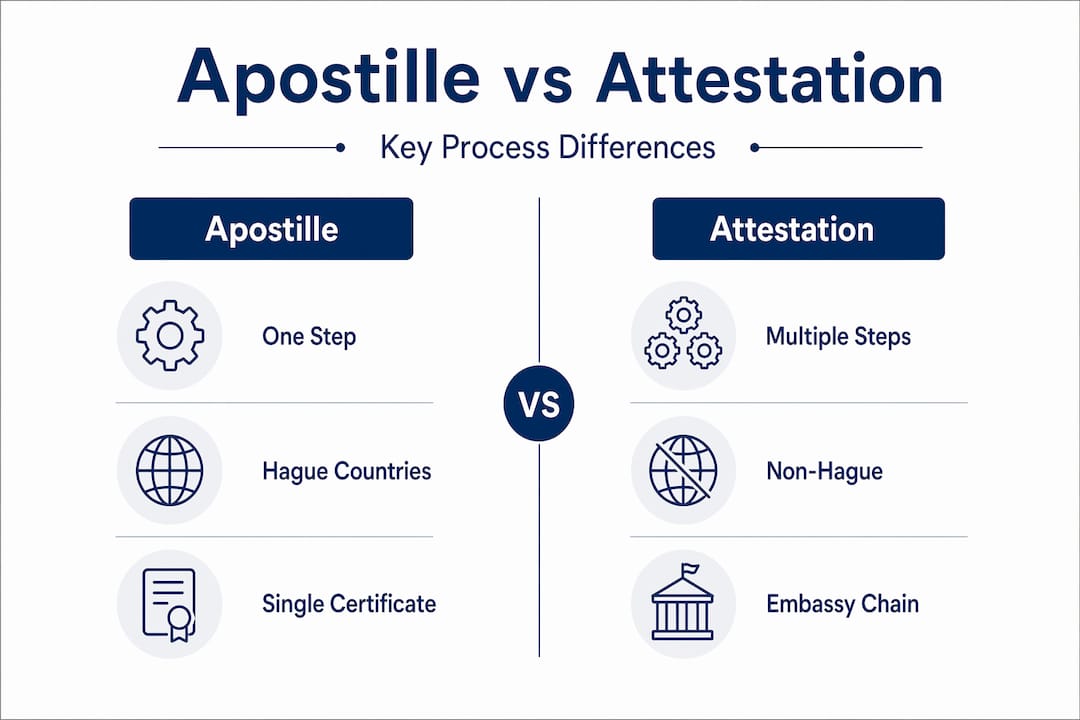
Feature | Apostille | Attestation |
Steps involved | 1 (single certificate) | 4 or more |
Issuing authority | Designated national/state body | Chain of agencies plus embassy |
Applicable countries | Hague Convention members | Non-Hague countries |
Typical time | Days to 2 weeks | 2 weeks to 2 months |
Cost | Lower (single process) | Higher (multiple fees) |
Embassy involvement | Not required | Required for final legalization |
Pro Tip: If translations are required, confirm this with the receiving authority before you submit anything. Translations are often required after apostille or attestation depending on destination requirements, and getting this wrong after the fact means starting parts of the process again.
Real-world use cases
Knowing the theory helps. Seeing it applied to specific situations helps more.
You are sending your college diploma to Germany for a job application. Germany is a Hague Convention member. You need an apostille on your diploma, issued by your state’s Secretary of State. No embassy visit required.
You are a Filipino OFW submitting a birth certificate to a UAE employer. The UAE is not a Hague member. Your document goes through the full attestation chain: Philippine Statistics Authority authentication, Department of Foreign Affairs verification, and UAE embassy legalization. Understanding this helps you navigate UAE attestation without surprises.
You are using an FBI background check for a work visa in Saudi Arabia. Saudi Arabia is not a Hague member. Your federal document route goes through the U.S. Department of State for authentication, then to the Saudi embassy for legalization. This is a two-agency process on top of any notarization requirements.
You need a notarized contract recognized in Spain. Spain is a Hague member. Your notarized contract gets an apostille from the appropriate state authority, and Spain accepts it without further embassy involvement.
You are submitting a death certificate for estate purposes in a non-Hague country. Authentication alone is usually insufficient for non-Hague countries. Consular legalization must follow, making attestation the correct and complete process.
The difference between attestation and notarization is worth clarifying here too. Notarization is the first step in both processes. A notary verifies the document is authentic and that any signatures are genuine. Attestation and apostille are what happens after notarization to make that document valid internationally.
Practical tips to avoid costly mistakes
Getting the process right from the start saves you money and time. Here is what to do before you submit anything:
Confirm destination country status first. Check whether your receiving country is on the HCCH member list. This is your first and most important step.
Identify who issued your document. Federal vs. state document issuance determines whether you apply through your state Secretary of State or the federal Department of State.
Gather all supporting documents before starting. Many authorities require the original document, not a photocopy. Missing one item can restart the entire timeline.
Check translation requirements early. Ask the receiving employer, institution, or authority directly whether they need a certified translation alongside your apostille or attested document.
Use tracked delivery for physical submissions. Losing your original document in the mail is a serious problem. Always use tracked, insured mailing when sending originals to government offices.
Pro Tip: When in doubt about which process applies, contact the embassy or consulate of your destination country directly and ask. They deal with these questions daily and will give you a definitive answer faster than any online research.
A common misconception worth addressing: people sometimes believe that getting an apostille on a document makes it valid everywhere. It does not. Apostille certificates are only recognized by countries that are members of the 1961 Hague Convention. Submit an apostilled document to a non-Hague country, and it may be rejected entirely.
My take: the mistake I see most often
I have worked with Filipino expats in the UAE long enough to know what trips people up. The most common mistake I see is not about documents at all. It is about assumptions.
People assume that because they have done this before, or because a friend told them what to do, they know the right process for their situation. But what worked for someone sending documents to Canada does not apply to someone sending them to the UAE. These are two completely different legal situations.
In my experience, the moment someone learns that the destination country’s treaty status is the deciding factor, everything clicks. It reframes the entire question. You stop asking “what kind of document do I have?” and start asking “where is this going?” That shift alone prevents the most expensive and time-consuming errors I see.
I have also seen people underestimate how long attestation actually takes, especially when embassy appointments are required. Planning for two weeks and ending up at six is a real scenario. Build in buffer time, and if there is a deadline attached to your submission, start the process earlier than feels necessary. You will be glad you did.
— Harris
Let Harrisncharms handle this for you
Figuring out which process your documents need is one thing. Actually getting it done correctly, on time, and without missing a step is another.

At Harrisncharms, we specialize in document attestation and apostille services for Filipino expats in the UAE. We know exactly which documents require full attestation for UAE submission, what the embassy needs at each stage, and how to move your paperwork through the process without avoidable delays. Whether you are dealing with educational certificates, civil documents, or background checks, we handle the details so you can focus on what actually matters. Visit our services page to see how we can help you get your documents certified right the first time.
FAQ
What is the main difference between apostille and attestation?
Apostille is a single certificate issued for countries that are members of the 1961 Hague Convention, while attestation is a multi-step process that includes embassy legalization and is required for countries outside the convention.
Does the UAE accept apostille?
No. The UAE is not a member of the Hague Convention, so documents submitted there require full attestation, including embassy legalization, not an apostille.
What is the difference between attestation and notarization?
Notarization is the first step where a notary verifies a document’s authenticity. Attestation is the broader international process that follows notarization, involving multiple government agencies and embassy legalization for the document to be accepted abroad.
Can I use an apostille for a non-Hague country?
No. Apostille certificates are only recognized by Hague Convention member states. Submitting an apostilled document to a non-member country will likely result in rejection.
How do I know which authority issues my apostille in the U.S.?
It depends on who issued the document. State-level documents like birth certificates go through the Secretary of State, while federal documents like FBI background checks are processed by the U.S. Department of State Office of Authentications.
Recommended
Comments